
What Probate Covers in Noble County
Probate is the court process that settles what a person leaves behind and protects people who cannot manage their own affairs. In Noble County it reaches estates of people who have died, wills, the appointment of executors and administrators, inventories of property, payment of valid debts, and the final transfer of what remains to heirs or named beneficiaries. The same division also hears guardianships for minors and incapacitated adults, conservatorships over property, and trust proceedings.
Oklahoma does not run a stand-alone surrogate or orphans' court. Probate is handled in the Probate Division of the District Court, so a Noble County estate case is a District Court case. The Court Clerk keeps the file, assigns the case number, and stores every petition and order. Judges who hear felonies and civil suits also sign the orders that admit a will or appoint a guardian.
Knowing that probate sits inside the District Court matters for searching. The same statewide tools that hold criminal and civil dockets also hold Noble County probate records.
Probate Terms in Noble County Cases
Probate filings use a handful of words that carry exact legal meaning. The definitions below cover the terms most readers run into when they open an estate or guardianship file in Noble County.
- Testator
- The person who made and signed the will. After death, that person's will is what the court reviews and admits.
- Executor
- The person named in the will to gather assets, pay debts, and distribute the estate under the court's supervision.
- Administrator
- The person the court appoints to settle an estate when there is no will or no named executor able to serve.
- Intestate
- Dying without a valid will. State law then decides who inherits and in what shares.
- Letters testamentary
- The court document that gives an executor legal authority to act for the estate. Letters of administration do the same when there is no will.
- Guardianship
- Court-granted authority to make care and decision choices for a minor or an incapacitated adult, called the ward.
- Conservatorship
- Court oversight of an adult's property and finances when that person cannot manage them alone.
How to Search Noble County Probate Records
The main path to a Noble County probate record runs through two free public systems. The Oklahoma State Courts Network (OSCN) at oscn.net/dockets lists Noble County District Court, and On Demand Court Records (ODCR) at odcr.com also carries Noble in its court list. Both let you view dockets at no cost. Documents themselves often stay at the courthouse, so the online docket tells you what exists and where to ask for a copy.
Searching by a decedent's or ward's name is the most common approach. The steps below follow the order most people use.
- Open OSCN docket search if you already know the case number. Pick Case Number Lookup, choose Noble County District Court, and enter the number. Probate files usually carry a PB or PR prefix.
- Switch to ODCR to search by person. Select the court group, choose Noble as the court, then enter the party name in Last, First format and pick a probate case type.
- Narrow the results with a filed date range or an activity date when a common name returns many cases.
- Call or visit the Court Clerk for certified copies, sealed-status questions, older estates, or anything that does not appear online. The screen display is not a certified record.
The field set below shows the ODCR inputs that matter most for a probate search.
| Search Field | How to Use It for Probate |
|---|---|
| Court | Select Noble to limit results to the local District Court. |
| Party name | Enter the decedent or ward as Last, First. |
| Type of case | Choose Probate Proceedings, Guardianships, Conservatorship, Trust Proceedings, or Filing of Wills. |
| Full case number | Use a PB or PR prefix with the year if the number is known. |
| Filed date range | Set a start and end date to bracket when the case opened. |
| Activity date | Filter by recent case activity to find active estates. |
Noble County Probate Case Types in ODCR
Probate is not one single category. ODCR splits estate and protective matters into several case types, and picking the right one speeds up a Noble County search. Filing of wills, for instance, is its own category and does not always mean a full estate has been opened.
| Case Type | What It Covers |
|---|---|
| Probate Proceedings | Administration of an estate, with or without a will, including appointment of a personal representative. |
| Probate Miscellaneous Proceedings | Related or ancillary estate filings that fall outside a standard full administration. |
| Guardianships | Care and decision authority for a minor or an incapacitated adult. |
| Conservatorship | Management of an adult's property and financial affairs. |
| Trust Proceedings | Administration or disputes involving a trust. |
| Filing of Wills | Depositing a will with the court, sometimes without opening a full estate. |
| Writs of Habeas Corpus | Custody-related writs grouped within this set of categories. |
Note: A docket entry under Filing of Wills shows a will was deposited, not that property has been distributed or that an executor has been appointed.
Where to File Noble County Probate Records
Every Noble County probate, guardianship, and conservatorship case opens with the Court Clerk at the courthouse in Perry. That office assigns the case number, accepts petitions and wills, and produces certified copies once a judge signs an order. There is no separate probate building to visit. Marriage and divorce filings move through the same Court Clerk, so a single office handles most family and estate paperwork. Readers tracking those records can compare the routes on the Noble County marriage and divorce records page.
Noble County District Court Probate Division
Court Clerk Hillary Vorndran
300 Courthouse Drive
Perry, OK 73077
580-336-5187
Wills and Estate Administration in Noble County
When someone dies owning property in their own name, the estate often needs court probate before that property can change hands. A petition asks the District Court to admit the will and appoint a personal representative. If there is no will, the court appoints an administrator and the estate passes under Oklahoma's intestate rules. From there the representative inventories the assets, notifies creditors, pays valid claims, and asks the judge to approve a final distribution.
Not every asset needs this process. Property held in joint tenancy, accounts with named beneficiaries, and assets inside a living trust can pass outside probate. Real estate, though, usually requires formal handling so the title record stays clean.
When an estate owes more than it holds, the debt side can move outside county probate. The federal U.S. Bankruptcy Court for the Northern District of Oklahoma handles bankruptcy filings for the region that includes Noble County.
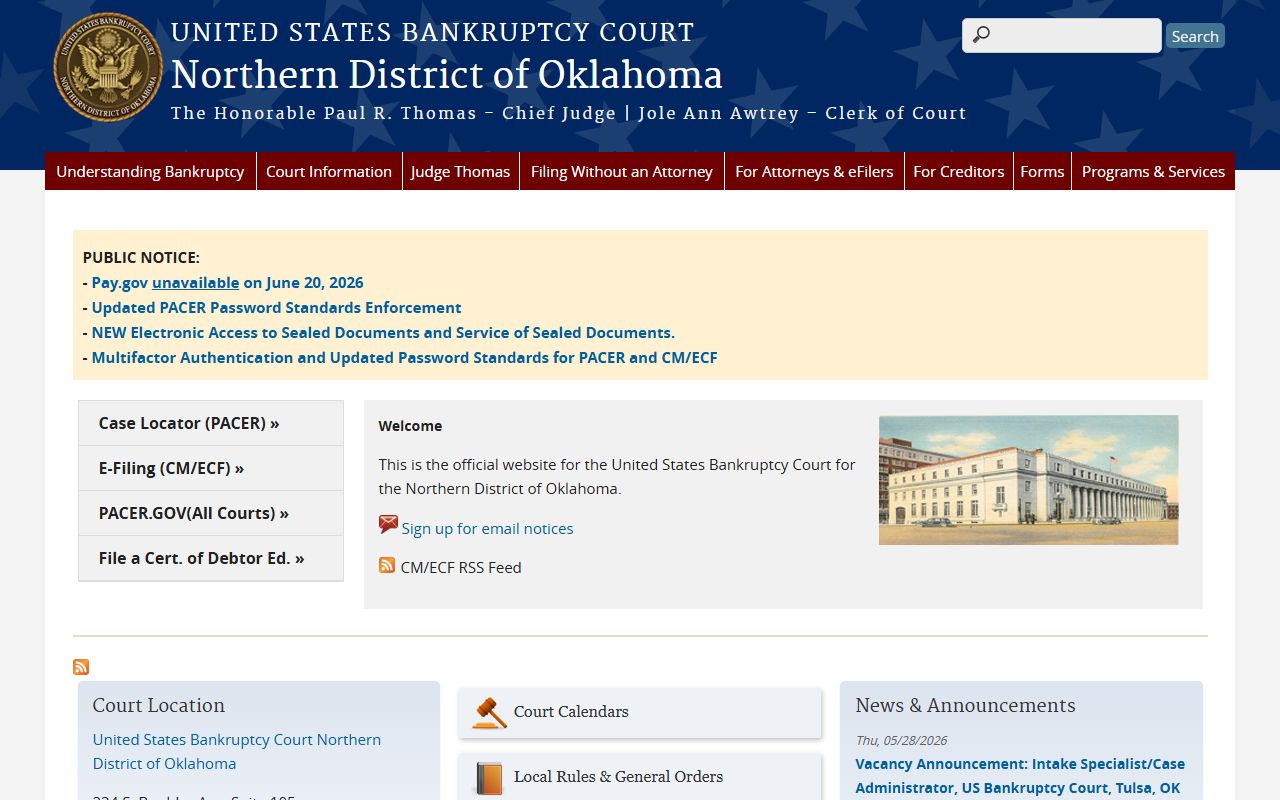
An insolvent estate or a deceased debtor's bankruptcy is a federal matter, kept apart from the will and estate file the District Court probate division stores. Most ordinary Noble County probate cases never reach that court, and the two systems do not share a docket.
Guardianship and Conservatorship in Noble County
Guardianship and conservatorship cases protect people who cannot fully protect themselves. A guardian handles personal and care decisions for a minor or an incapacitated adult, while a conservator manages money and property. These files can hold medical reports, capacity evaluations, and details about a minor, so public access may be limited even when a docket exists.
Guardianship and estate questions sometimes involve a person who is in custody. The vendor that runs jail visitation and phone service, Prodigy Solutions, is the county's communication provider rather than a probate tool.

If a proposed ward or an heir sits in the county jail, a guardian or executor may still need to reach that person, and contact runs through the scheduled video and phone system, not the court file. Money for an incarcerated relative runs through a separate deposit vendor, JailATM, which the jail uses for commissary funds.

That deposit portal moves commissary money, never estate assets. Estate funds and conservatorship accounts are handled through the probate case and the court-appointed representative, not through any jail payment site.
Small-Estate Affidavits in Oklahoma
Not every estate needs a full District Court case. Oklahoma provides affidavit routes for smaller estates that can avoid formal probate. Service Oklahoma offers a small-estate affidavit to transfer a vehicle subject to disposition by will when the total estate value is no more than $50,000. Oklahoma Bar material also describes an affidavit route for personal property under $50,000, available after at least ten days when no personal representative has been appointed and no probate petition is pending.
Note: A small-estate affidavit is not a Noble County District Court probate case, and real property usually still requires more formal handling to clear title.
County Clerk Records Tied to Estates
The probate case file lives with the Court Clerk, but an estate often touches records held by a different office. The Noble County Clerk records deeds, mortgages, oil and gas instruments, plats, and liens, all of which can matter when an estate includes real property or mineral interests. After a court approves a transfer, the resulting deed is recorded with the County Clerk, not the Court Clerk.
Those recorded instruments are searchable through the OKCountyRecords Noble County portal, which holds indexed data from June 1996 and scanned images from July 1996. Mineral interests are common in Noble County, so heirs often need both the probate file and the land record to see the full picture. The County Clerk does not, however, hold the probate case itself.
What Noble County Probate Records Show
A probate file builds up a clear paper trail from opening to closing. Most estate and guardianship cases include a recognizable set of documents that a searcher can expect to find listed on the docket.
- Petitions to open the estate or appoint a guardian
- The will and any order admitting it to probate
- Letters testamentary or letters of administration
- Inventories of estate property and appraisals
- Notices to creditors and claims filed against the estate
- Accountings, sale approvals, and orders of distribution
- Final decrees, guardianship orders, and bond information
The docket lists each filing by date, while the documents may sit at the Court Clerk's office rather than online. For estate research that crosses into other case types, the broader Noble County court records tools cover the same OSCN and ODCR systems.
Probate Filing Fees and Certified Copies
Filing a probate or guardianship petition carries court costs, and ordering certified copies of orders or letters adds a per-document charge. Oklahoma sets these amounts through state court fee schedules, and a deposit toward costs is usually collected when a case opens.
Exact Noble County probate filing and copy fees were not published in the official sources reviewed for this page. Rather than list a figure that might be wrong, the safe step is to confirm the current cost directly with the Court Clerk before filing or ordering copies. A short call to the office gives the deposit amount, the certified-copy rate, and accepted payment methods.
Important: An online docket display is not a certified record, and only a certified copy from the Court Clerk is accepted for transferring property or proving authority to act.
Restricted Noble County Probate Records
Most probate dockets are open to the public, but parts of a file can be withheld. Guardianship and conservatorship cases frequently include medical reports, capacity evaluations, and information about minors, and those details may be sealed even when the case index is visible. Mental-health records and physician communications are confidential under state law.
A sealed document or a protected identifier may not appear in an ordinary online search, and reaching it can require a court order or proof of standing. When a record matters and it is not visible online, the Court Clerk can confirm whether the file exists, whether any part is restricted, and how to request access.