
Noble County Arrest Records and Court Charges
A Noble County arrest record is the account of an arrest itself. It names the agency that made the arrest, the date and time of booking, and the offenses listed at intake. In most county arrests, the Noble County Sheriff's Office books the person into the jail at 721 Cedar Street in Perry and logs the booking charges on the jail roster. Those booking charges reflect what the arresting officer believed at the scene. They are a starting point, not a court filing. The next step belongs to the prosecutor, who reviews the arrest and decides which charges, if any, to file with the court.
The court charge record is a separate thing. When the District Attorney for District 8 files a case in Noble County District Court, the charges become part of the official case file kept by the Court Clerk. Those court charges after arrest carry statute citations, count numbers, and a status that the docket tracks as the case moves. The booking side and the charge side are stored in different places. For the jail roster and booking detail, the Noble County inmate records page covers the custody side. The full case file, pleas, and final outcome live with the criminal court records.
How to Find Noble County Arrest Records and Charges
Filed charges show up in the court case search. Two free systems carry Noble County District Court cases. The Oklahoma State Courts Network, known as OSCN, runs a docket search that lists Noble County District Court. On Demand Court Records, or ODCR, lists Noble in its court dropdown and lets you search by party name, case type, case number, or filed date. Both are free for public searching and docket viewing. Booking detail and the live jail roster sit on the sheriff's side, which the Noble County inmate records page covers.
- Open the OSCN docket search and pick Noble County District Court, or open ODCR and select court "Noble" for a name-based search.
- Search by the defendant's name in Last, First format, or enter the full case number if you have it.
- Open the matching case and read the charge list, where each count appears with its offense and statute.
- Check each charge's prefix, level, and current status, since charges can change after they are first filed.
The sheriff's own records sit apart from the court portals. To see how the sheriff publishes booking charges and handles formal copy requests, the Noble County Sheriff's Office records page lays out its records division and fee schedule.
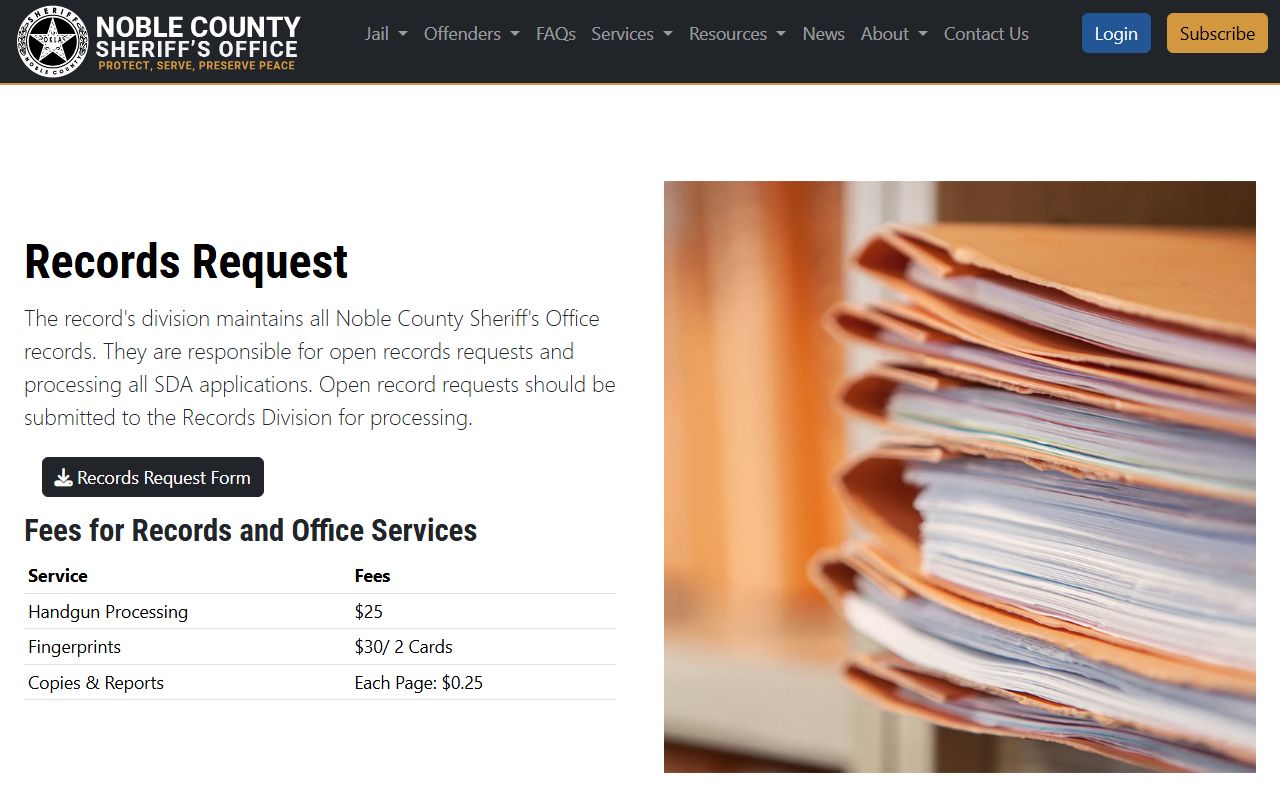
That records division is the fallback when a booking record, incident report, or arrest detail does not appear in the online court search.
How Charges Get Filed After an Arrest: Complaint, Information, and Indictment
The path runs in a clear order. The arrest happens first, and the person is booked at the jail. The court charge record begins only when the District Attorney for District 8 files a charging document with the Noble County Court Clerk. The DA can also decline to file, which is why a booking charge on the jail roster is not always the charge that ends up in District Court. Brian Hermanson serves as the district attorney for Kay and Noble Counties, with assistant district attorneys Chris Landes and Tom Lane handling cases out of the Perry courthouse office.
Three charging documents start a criminal case in Oklahoma. The sheriff who books the arrest and the prosecutor who files the charge are different officials in different offices, as the Noble County Sheriff Matt McGuire bio page makes plain.
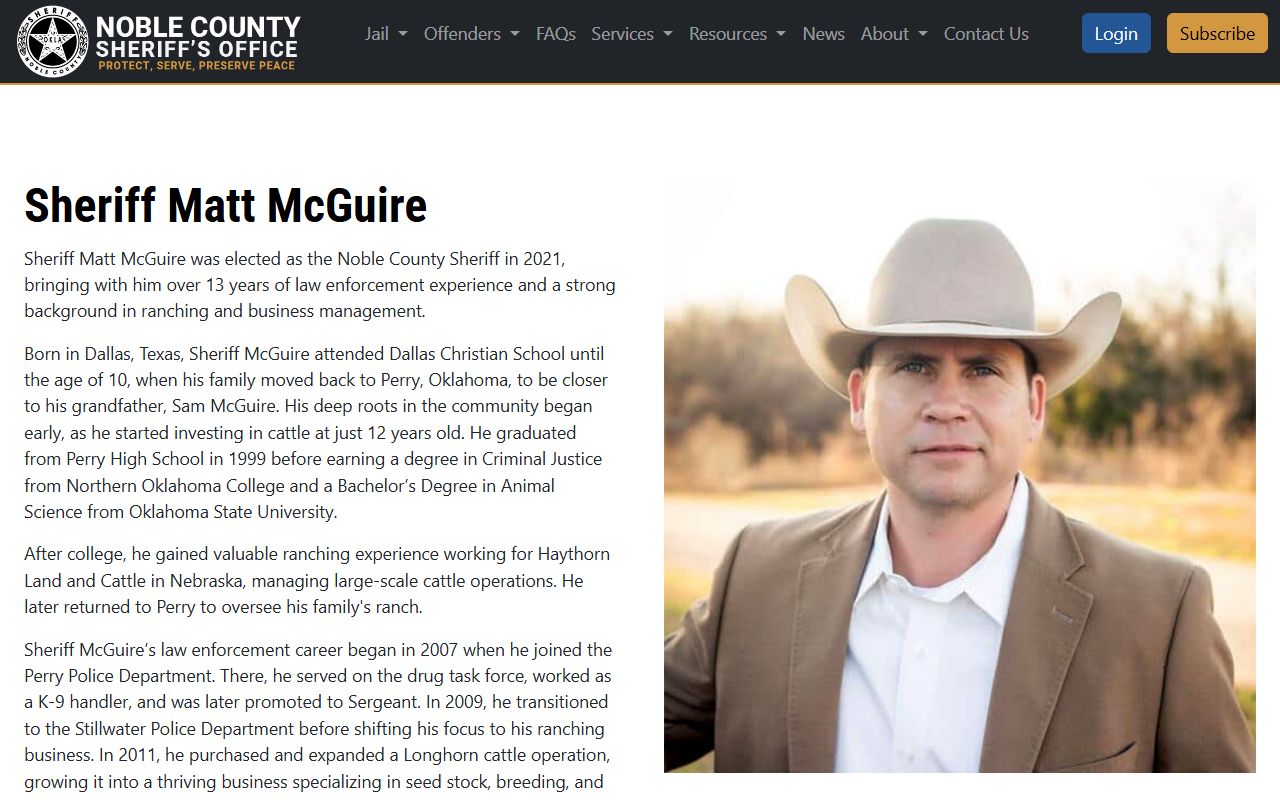
The sheriff makes and books the arrest; the district attorney decides the charges. The table below sums up the three documents that can open a case.
| Complaint | Information | Indictment | |
|---|---|---|---|
| Filed By | Officer / Prosecutor | Prosecutor | Grand Jury |
| Common For | Misdemeanors | Many felonies | Serious felonies |
| Starts | The case | The case | The case |
Charge Status and What It Means
A charge rarely stays frozen. As a Noble County case moves through arraignment, preliminary hearing, and plea or trial, the charges can be amended, reduced, added to, dropped, or dismissed. The docket records each change with a date and a code. Reading the current status matters, because an early booking charge may look serious while the filed and final charge is far lighter, or the reverse. The terms below are the ones that show up most often on an OSCN or ODCR docket.
| Status | What It Means |
|---|---|
| Pending | The charge is filed and active, with no final outcome entered yet. |
| Amended / Reduced | The prosecutor changed the charge, often to a lower level such as a felony cut to a misdemeanor. |
| Dismissed | The court dropped the charge, sometimes with prejudice (no refiling) or without prejudice (refiling allowed). |
| Nolle Prosequi | The prosecutor formally chose not to pursue the charge, ending it without a conviction. |
Note: A dropped or dismissed charge can still appear in the public docket history even after the case ends, unless the record is later sealed or expunged.
Charges vs. Convictions
Being charged is not the same as being convicted. A charge is an accusation. It means a prosecutor believes there is enough cause to take the case to court, nothing more. A conviction comes only after a guilty plea, a no-contest plea, or a verdict that finds the person guilty beyond a reasonable doubt. In a Noble County criminal case, the State of Oklahoma is the party that brings the charge, and the named defendant is presumed innocent until that higher standard is met. Many charges never become convictions. They get reduced, dismissed, or resolved through a deferred sentence instead.
| Charge | Conviction | |
|---|---|---|
| Stage | Accusation | Verdict or plea |
| Burden of Proof | Probable cause | Beyond reasonable doubt |
| Public Record | Yes | Yes |
Sealed vs. Expunged Records
Some charge records can be removed from public view. Oklahoma handles this under its expungement law, found at 22 O.S. Section 18. The Oklahoma State Bureau of Investigation, or OSBI, explains the eligible categories but cannot pre-approve a person's case. A petitioner usually files in the District Court where the arrest or charge sits, gives notice to the prosecutor and OSBI, and asks the judge to seal the qualifying records. Until that order is entered and processed, the charge can still appear in an OSCN or ODCR search.
| Sealed | Expunged | |
|---|---|---|
| Visibility | Hidden from public | Destroyed / treated as never existed |
| Law Enforcement | Limited access | Very limited |
| Eligibility | Court order limiting access to a qualifying record | Arrest, dismissal, acquittal, pardon, or conviction that meets a 22 O.S. Section 18 category |
Charge Codes and Severity Levels
Each charge ties back to a statute and a case prefix. In Noble County District Court, a felony case carries the prefix CF, and a misdemeanor case carries CM. The case number then adds the year and a sequence number, so a felony filed in a given year reads like CF followed by that year. Felonies are the most serious level and can bring prison time. Misdemeanors are lower-level offenses with lighter maximum penalties. ODCR also breaks criminal filings into Criminal Felony Proceedings, Criminal Misdemeanor Proceedings, Criminal Probable Cause, and Criminal Proceedings - Not Filed.
One arrest can produce several separate charges. A single incident might lead to one felony count plus two misdemeanor counts, each with its own statute citation and its own status on the docket. The offense or cause field on ODCR shows what each count alleges. Reading the prefix tells you the severity level quickly, but the statute citation is what pins the charge to a specific Oklahoma law.
Statewide Charge and Criminal History Lookups
Charges filed across Oklahoma roll up into a statewide criminal history kept by the Oklahoma State Bureau of Investigation. A county docket search shows Noble County cases, but a full background picture spans every county. The OSBI is the official state repository, and it also runs the expungement process described in its criminal history record expungement guidance. For people already sentenced to state custody, the Oklahoma Department of Corrections offender lookup tracks the outcome after a charge becomes a conviction. Public access to all of these records rests on the Oklahoma Open Records Act, 51 O.S. Section 24A.1 and following, which opens public-body records unless a law makes them confidential.
Background Check Considerations
There is a real gap between a casual lookup and a formal background check. Searching OSCN or ODCR to satisfy curiosity is one thing. Using charge records to decide on hiring, housing, or credit is another, and federal law governs that use. A charge record found online is not certified, and it may be incomplete or out of date. For an official certified copy of a Noble County charge record, the Court Clerk at the courthouse is the source.
Important: This site is not a consumer reporting agency under the Fair Credit Reporting Act, and its records may not be used for employment, tenant, credit, or insurance screening.
Restricted Charge Records in Noble County
Not every charge record is open to the public. Juvenile charges are confidential under 10A O.S. Section 1-6-102, so ordinary juvenile case files do not appear in a public search. Sealed and expunged charges drop out of OSCN and ODCR results once the court order is processed. Some probable-cause and not-yet-filed records stay limited until a charge is formally filed, and active investigative material can be withheld. Mental-health and adoption matters carry their own confidentiality protections as well.
When a charge record is public but does not show online, the sheriff and the Court Clerk both handle requests. The sheriff's records division charges $1 for the first page and $0.50 for each added page, with fingerprints at $30 for two cards. For certified copies of the court charge record, the Noble County Court Clerk at the courthouse on Courthouse Drive is the official source. The sheriff's contact page lists the main line and jail extension for booking and arrest questions.
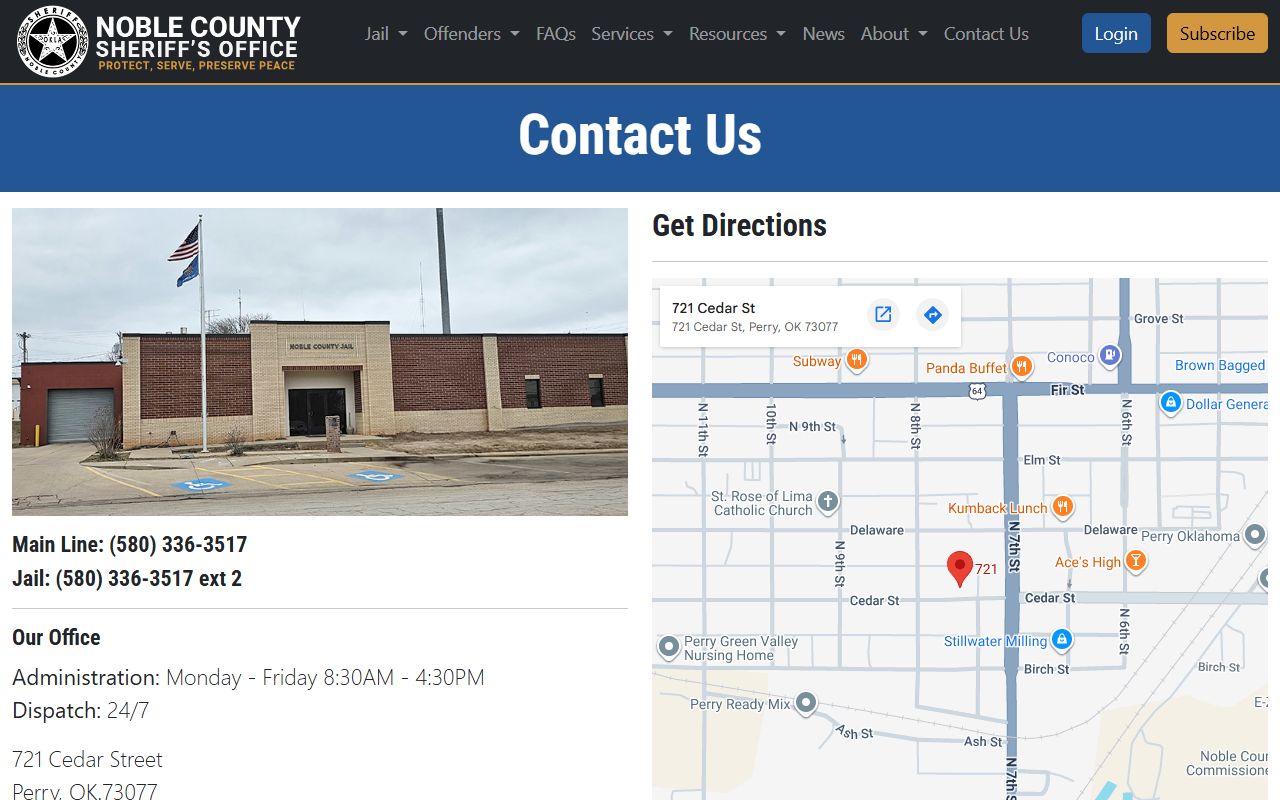
Use that contact line for the arrest side, and use the Court Clerk for the filed charges and certified court copies.